
Jul 9 – Aug 14
Amanda Atria, Alina Bliumis, Skyler Chen, Drew Dominguez, Joshua Jobb, Ruba Nadar, Serena Nickson, Maïa Régis, Melissa Ríos, Nicolas Shake, Brandon M. White, Gordon Winarick
Fan Clubs
Exhibition
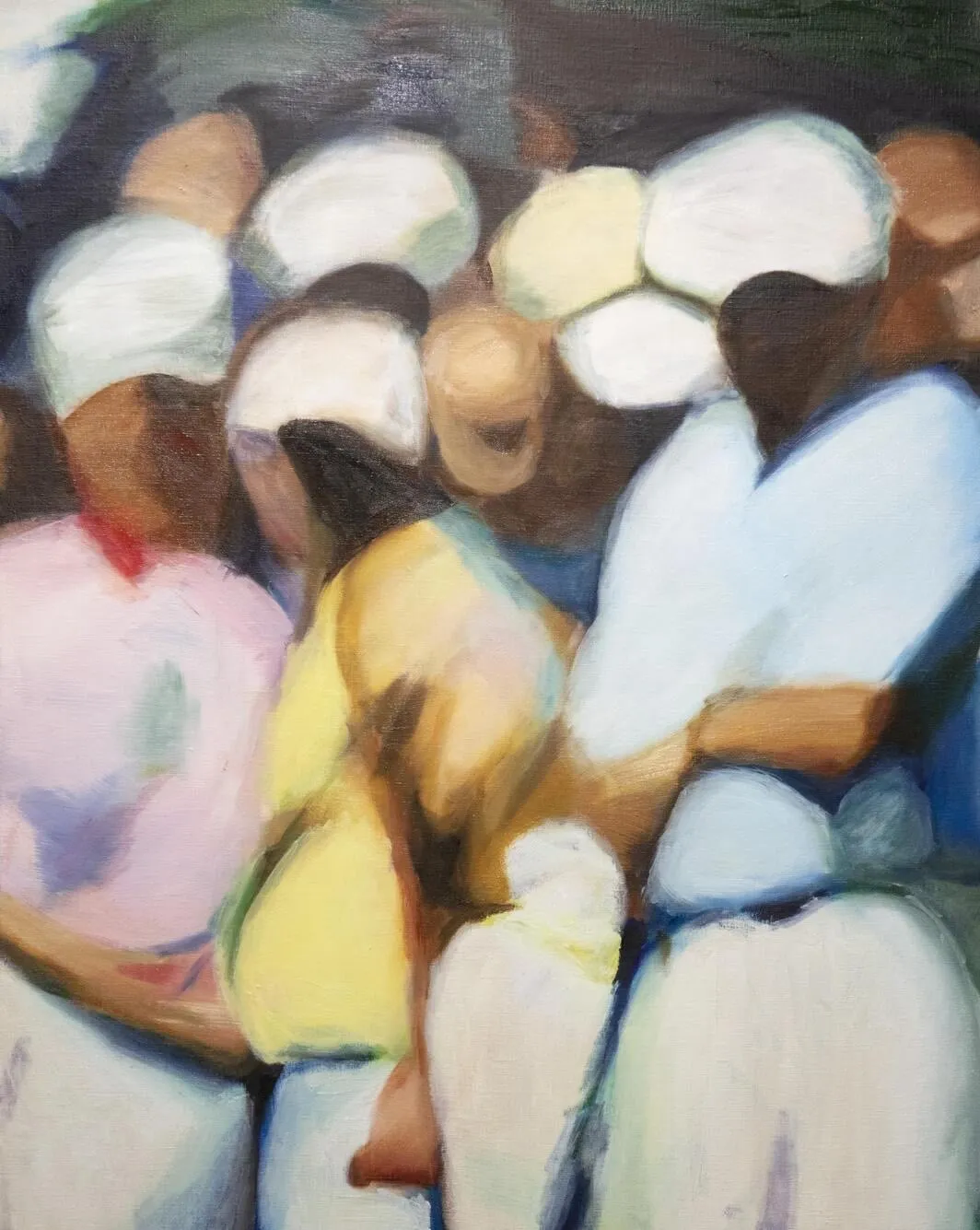
In this exhibition, the artists explore how participation in fan clubs, organized religion, sports teams, and collectives are all modes of belonging. It poses questions about when the architecture of a fan club takes the shape of a cult. When does devotion become religion? By design, there is a kind of parasocial structure in which fans feel genuine intimacy with someone who does not know they exist. Fans of the same celebrity often form intense communities with one another, making the celebrity almost a pretext. The real belonging is horizontal, between fans, rather than vertical toward the idol.
The fan is constitutively passive: they watch, they feel, they suffer vicariously. The athlete or performer acts. A deep psychological transaction takes place, in which the fan delegates their own unlived potential to the person on the field or stage. The athlete becomes a vessel for everything the fan might have been. The athlete becomes a symbol for a god.
The word fan is a wound in language. Clipped from fanatic, itself descended from the Latin fanaticus, meaning “inspired by a deity” or “belonging to the temple,” it has been scrubbed of its religious charge and reassigned to the bleachers, the arena floor, and the streaming queue. As a crowd erupts after a goal, a congregation rises during a hymn, or a stadium full of strangers chants a single name in unison, you are witnessing the same phenomenon wearing different clothes. The question Fan Clubs asks is not which of these is more legitimate: the sacred or the secular, the devotional or the recreational, but rather: what separates a healthy fan community from a cult? Is it power? Is it the ability to leave?