
May 2 – Aug 1
Max Liebermann
A Key to the Garden
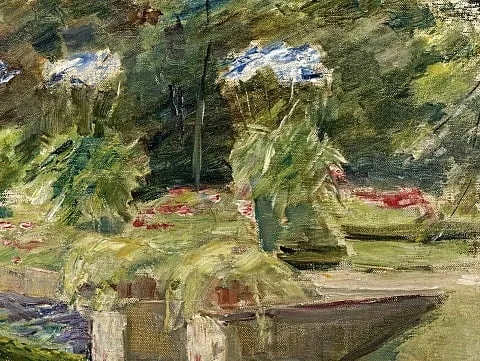
Max Liebermann was 62 years old when, in 1909, he commissioned the construction of a country house on the western shore of Lake Wannsee, on the outskirts of Berlin. The architecture and garden were developed in close collaboration with his friend Alfred Lichtwark, forming a deliberately conceived unity.
The garden draws on models of European monastic gardens as well as on the idea of the English cottage garden, which were reformulated in Germany after the turn of the century by Hermann Muthesius and the garden philosopher Karl Förster as a language of formal artifice. Conceived in clearly defined beds, the garden becomes the pictorial reservoir of Liebermann’s painting. In this respect, it stands in conscious opposition to a poetically conceived artist’s garden such as Claude Monet’s in Giverny. Liebermann does not seek a literarily elevated Gesamtkunstwerk, but rather a controlled, sober engagement with nature.