
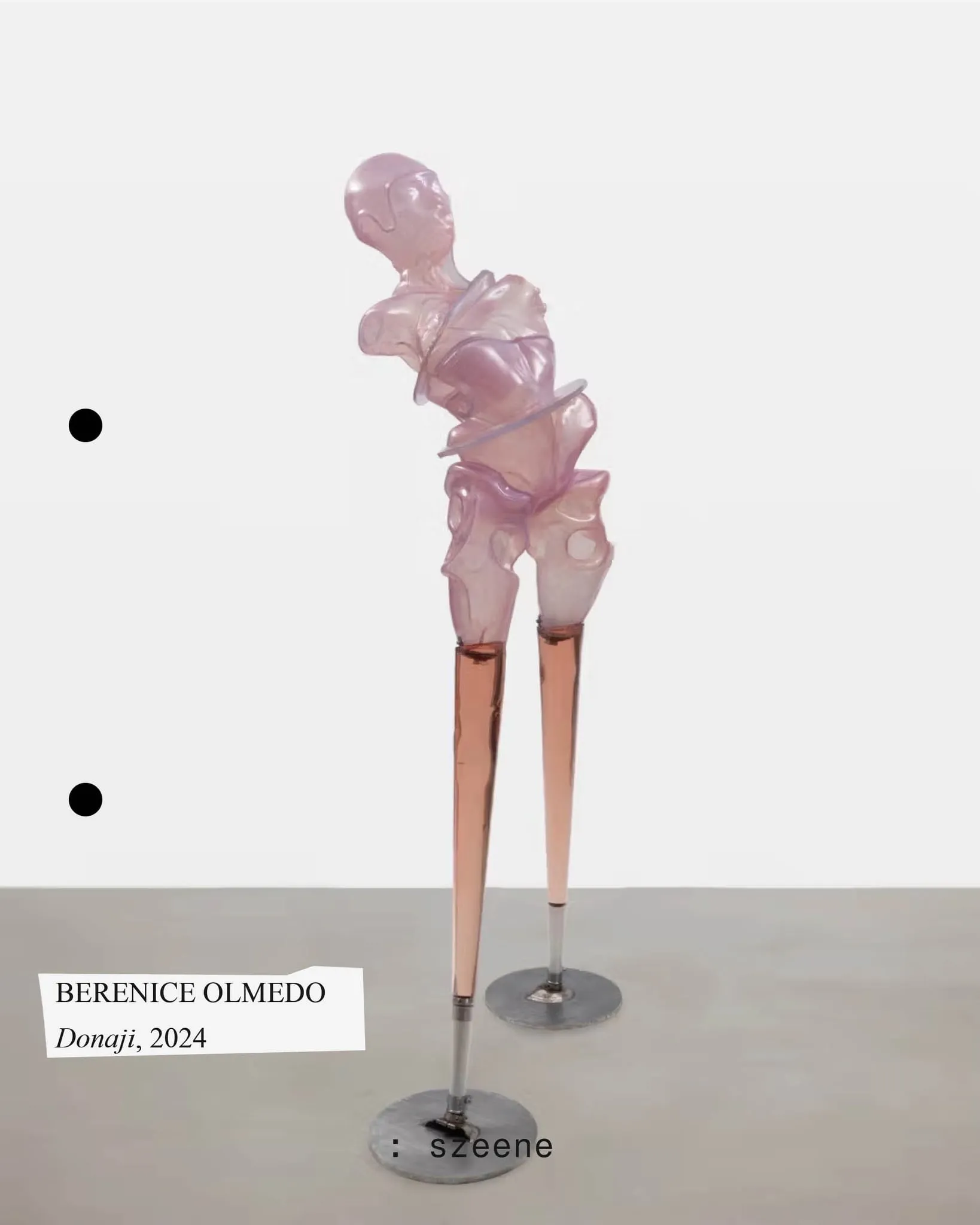
Berenice Olmedo
Berenice Olmedo’s sculptures originate in prosthetic and orthotic sockets — devices designed to support, stabilize, and extend the human body — which she scans, reproduces, and repositions. What once served a precise technical function becomes a new kind of presence: forms that carry the memory of their origin yet no longer belong to it, extending outward from systems of care and correction into a register where function gives way to autonomy. Their copper and silver surfaces, oxidized through time and chemical treatment, behave as a reactive skin that registers transformation long after the form is set. Her practice tests the limits of the body — at points of contact, pressure, and exposure, where it meets what supports or replaces it — proposing that an individual is never singular or self-contained, but composed through overlapping structures, supports, and projections.
Courtesy of the artist Berenice Olmedo and the gallery Jan Kaps, Cologne.
June 4, 2026